World historyAD 960 – 150037 events

Song, Ming and Samurai Japan

The age when the civil-minded Song bought peace from Liao, Western Xia and Jin while the lower Yangtze boomed and Neo-Confucianism took shape, and the Ming, having driven out the Yuan, rebuilt the East Asian order through imperial autocracy, the sea ban and tribute — as Japan passed through the Kamakura and Muromachi warrior governments into the Warring States era, and Korea from Goryeo to Joseon

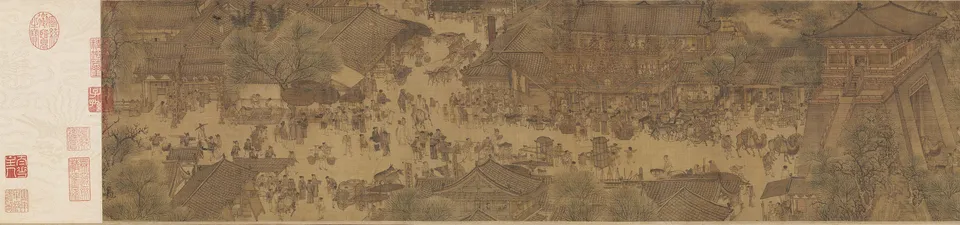
장택단의 「청명상하도」 첫 부분 — 북송의 수도 카이펑 교외의 풍경 (12세기)

Image provided by Baidu Tieba, Spliced by SJLD · CC0 · Source

At a glance

TopicChina (Song–Yuan–Ming)JapanGoryeo and Joseon
Ruling classExam-chosen scholar-officialsWarriors — shogun and vassalsAristocrats → generals → new literati
Northern peoplesPeace bought with paymentsTwo Mongol invasions repelledKhitan repelled; vassal of Jin
Warrior ruleGovernors curbed; army under throneKamakura shogunate (1185/1192)Military coup (1170), Choe regime
Economy, technologyLower Yangtze; jiaozi; compass, typeSong coins spread money economyByeongnando; celadon; metal type
Thought, religionZhu Xi’s Neo-ConfucianismKamakura Buddhism (Pure Land, Zen)Neo-Confucianism → Joseon ideology
The MongolsJin, Song fall; Yuan (1271)Invasions repelled; shogunate shakenLong resistance, then Yuan dominance
14th-century changeRed Turbans → Ming (1368)Muromachi; courts reunited (1392)Joseon founded (1392)
Wokou piratesSea ban, coastal defenceBases on Tsushima, Iki in civil warHongsan, Jinpo, Hwangsan; Tsushima
Foreign tradeSea ban — tribute trade onlyTally trade (1404)Sadae–gyorin; three ports, Gyehae
CapitalsKaifeng → Lin’an → Dadu → Nanjing → BeijingKamakura → Muromachi, KyotoGaegyeong → Hanyang (1394)
Late 15th centuryAfter Tumu (1449), defence in northŌnin War (1467) → SengokuGyeongguk daejeon; Three Ports Revolt

The theme on the map

OpenFreeMap © OpenMapTiles © OpenStreetMap contributors

37 events in this theme

  1. Zhao Kuangyin (Emperor Taizu), a Later Zhou general, founded the Song in the Chenqiao mutiny of 960, took military power from the governors into imperial hands and favoured civil officials chosen by examination. China proper was reunified in 979.

  2. The Khitan Liao invaded Goryeo three times between 993 and 1019. Goryeo repelled them through Seo Hui’s diplomacy and Gang Gam-chan’s victory at Gwiju.

  3. When Emperor Shengzong of Liao led a great Khitan army down to the Yellow River in 1004, Emperor Zhenzong of Song went to Chanzhou and made peace. In return for annual payments of silk and silver from the Song, the two states lived as “brothers” in peace for nearly 120 years.

  4. Goryeo forces under Gang Gam-chan crushed a 100,000-strong Khitan army at Gwiju.

  5. Under the Song the lower Yangtze was developed and the economic centre shifted south; commercial cities and paper money (jiaozi, huizi) appeared. The compass, gunpowder and movable-type printing came into practical use and spread across the world.

  6. Li Yuanhao of the Tanguts proclaimed himself emperor of Great Xia (Western Xia) in 1038. He had a Tangut script created, fought the Song into a treaty of annual payments in 1044 and held the Hexi Corridor, the east–west trade route.

  7. Emperor Shenzong of Song appointed Wang Anshi in 1069 to rebuild state finances and the army with the New Policies — the green sprouts, hired service, state trade, equitable transport, baojia and horse-breeding laws. Opposition from Sima Guang and the Old Policies party led to lasting factional strife.

  8. Yun Gwan led 170,000 men of the Byeolmuban against the Jurchens and built nine forts in the northeast, but they were handed back after little more than a year.

  9. Aguda of the Wanyan Jurchens rose against the Liao and founded the Jin in 1115. With an army organised in meng’an–mouke units and an alliance with the Song, he destroyed the Liao by 1125.

  10. Yi Ja-gyeom, King Injong’s maternal grandfather and father-in-law, burned the palace with Cheok Jun-gyeong and held the king captive; Injong won Cheok over and removed Yi.

  11. The Jin took Kaifeng and in 1127 carried off the Song emperors Huizong and Qinzong and their court to the north (the Jingkang Incident). Qinzong’s brother Gaozong took the throne in the south to continue the dynasty as the Southern Song, which made peace with Jin in 1141 with the Huai River as the border.

  12. Myocheong and Jeong Ji-sang of the Western Capital urged moving the capital there, proclaiming an emperor and attacking Jin; rebuffed, they rebelled in Seogyeong and were crushed within a year by government forces under Kim Bu-sik.

  13. Generals including Jeong Jung-bu, Yi Ui-bang and Yi Go, long slighted by civil officials, struck at Bohyeonwon, killing civil officials and deposing King Uijong; military regimes ruled for the next century.

  14. Minamoto no Yoritomo destroyed the Taira in the Genpei War, won the right to appoint shugo and jitō in 1185 and became seii taishōgun in 1192. It was the start of warrior government (the bakufu), bound by land and loyalty between shogun and vassals, that would rule Japan for nearly 700 years.

  15. Zhu Xi of the Southern Song drew together the work of Northern Song thinkers into Neo-Confucianism (the Zhu Xi school), built on the theory of principle and material force and the doctrine that human nature is principle, and published the Collected Commentaries on the Four Books. It became the examination standard under the Yuan and Ming and, reaching Korea in late Goryeo, the ruling ideology of Joseon.

  16. Temüjin was proclaimed Genghis Khan at a kurultai. The Mongol Empire became the largest contiguous land empire in history.

  17. Genghis Khan invaded the Jurchen Jin and overran northern China; Ögedei Khan, allied with the Southern Song, destroyed the Jin in 1234.

  18. Yuan forces took Xiangyang and received the surrender of the Song capital Lin’an. In 1279 the last Song fleet was destroyed at Yamen, and all of China came under the rule of a northern nomadic people for the first time.

  19. Kublai adopted the dynastic name Great Yuan and made Dadu (present-day Beijing) his capital. The Mongol Empire divided into the Yuan and several khanates.

  20. The Yuan, using Goryeo as its spearhead, twice invaded Japan, and both times its fleets were wrecked by storms. Supplying ships, troops and grain placed a heavy burden on Goryeo.

  21. Under King Chungnyeol, An Hyang brought Neo-Confucianism from the Yuan; through Yi Je-hyeon and Yi Saek it became the creed of new scholar-officials such as Jeong Mong-ju and Jeong Do-jeon.

  22. After the fall of the Kamakura shogunate, Ashikaga Takauji broke with Emperor Go-Daigo, set up a Northern Court in Kyoto in 1336 and became shogun in 1338. The civil war against the Southern Court at Yoshino lasted until Ashikaga Yoshimitsu reunited the courts in 1392.

  23. From about 1350 Japanese pirates (wokou) raided Goryeo’s coasts and interior year after year; commanders such as Choe Yeong, Choe Mu-seon, Yi Seong-gye and Jeong Ji drove them off, and a new military elite rose in the process.

  24. As the Yuan gave way to the Ming, King Gongmin purged the pro-Yuan faction, recovered the Ssangseong Commandery, and, through Sin Don, curbed the magnates to restore royal power.

  25. The Red Turbans, Han Chinese rebels against the late Yuan, invaded Goryeo twice; in the second invasion Gaegyeong fell and King Gongmin fled to Bokju (Andong).

  26. Zhu Yuanzhang, who rose amid the Red Turban Rebellion of the late Yuan, became emperor at Nanjing in 1368 and founded the Ming. When Ming forces took Dadu that year, the Yuan court withdrew to the Mongolian plateau as the Northern Yuan.

  27. In 1380 the Hongwu Emperor abolished the chancellorship and the Secretariat, placing the Six Ministries directly under the throne, and governed the countryside through the lijia system and the Yellow Registers and Fish-scale Registers. He instructed the people with the Six Edicts and banned private sea trade.

  28. When the Ming claimed the land north of Cheollyeong, King U and Choe Yeong launched an expedition against Liaodong, but Yi Seong-gye turned the army back at Wihwado, ousted Choe Yeong and seized power.

  29. Yi Seong-gye overthrew Goryeo and founded Joseon, moving the capital to Hanyang in 1394.

  30. When the Jianwen Emperor curbed the power of his uncles after Hongwu’s death, Zhu Di, Prince of Yan, rose in 1399 (the Jingnan campaign), took Nanjing in 1402 and became the Yongle Emperor. In 1421 he moved the capital to his own base, Beijing.

  31. In return for being invested by the Ming as “King of Japan” and suppressing pirates, Ashikaga Yoshimitsu won tributary trade with China from 1404, open only to ships carrying a tally (kangō) to prove their identity.

  32. 1405 – 1433Voyages of Zheng He

    At the Yongle Emperor’s command the eunuch Zheng He led seven great fleets between 1405 and 1433 through Southeast Asia to India, the Persian Gulf, Arabia and East Africa, displaying Ming power and enlisting new tributary states.

  33. To strike the pirates at their base, Yi Jong-mu attacked Tsushima with some 200 ships; trade was later allowed under the 1443 treaty.

  34. Shō Hashi of Chūzan unified Ryukyu, long divided among three Okinawan kingdoms, in 1429 and made Shuri his capital. As a Ming tributary, Ryukyu prospered on entrepôt trade linking China, Japan, Korea and Southeast Asia.

  35. Under Sejong, Joseon concluded an agreement with the lord of Tsushima limiting trade with Japan to 50 ships and 200 seok of rice a year.

  36. When Esen of the Oirats invaded in 1449, the Ming Zhengtong Emperor, urged on by the eunuch Wang Zhen, took the field himself and was routed and captured at Tumu. Yu Qian set a new emperor on the throne and held Beijing, and thereafter the Ming stood on the defensive in the north.

  37. A succession dispute over the shogun Ashikaga Yoshimasa, entangled with feuds among powerful shugo houses, set off the Ōnin War in Kyoto, which lasted eleven years from 1467. The shogunate’s authority collapsed and the Warring States (Sengoku) period began, with rival daimyo fighting amid gekokujō — “the low overthrowing the high”.

Key people

  • Taejo (Yi Seong-gye)1335 – 1408

    Founder and first king of Joseon, formerly a general who fought Japanese pirates and the Red Turbans

  • Kublai Khan (Emperor Shizu of Yuan)1215 – 1294

    Fifth Great Khan and founder of the Yuan dynasty, who made peace with Goryeo and launched the invasions of Japan

  • Choe Yeong1316 – 1388

    General who fought the Red Turbans and Japanese pirates, won at Hongsan in 1376, and was executed after the Wihwado retreat

  • Yongle Emperor (Chengzu of Ming)1360 – 1424

    Third Ming emperor (r. 1402–1424), who seized the throne from his nephew the Jianwen Emperor in the Jingnan campaign, moved the capital to Beijing and sent out Zheng He’s fleets

  • Gang Gam-chanAD 948 – 1031

    Commander-in-chief who won the Battle of Gwiju in 1019 and proposed the outer wall of Gaegyeong

  • Emperor Shengzong of LiaoAD 971 – 1031

    Khitan emperor who personally led 400,000 troops into Goryeo in 1010, using Gang Jo’s coup as a pretext

  • King Injong1109 – 1146

    Seventeenth king of Goryeo, who faced the revolts of Yi Ja-gyeom and Myocheong and commissioned the Samguk sagi

  • Yi Saek1328 – 1396

    Late Goryeo Neo-Confucian who, as head of the Seonggyungwan under King Gongmin, trained Jeong Mong-ju and Jeong Do-jeon

  • Ashikaga Yoshimitsu1358 – 1408

    Third Muromachi shogun (r. 1368–1394), who reunited the Northern and Southern Courts in 1392, was invested by the Ming as “King of Japan” to open the tally trade, and built the Golden Pavilion

  • King Gongmin1330 – 1374

    Thirty-first king of Goryeo, who led anti-Yuan reforms, recovered the Ssangseong Commandery and backed Sin Don’s reforms

  • Hongwu Emperor (Taizu of Ming)1328 – 1398

    Founder of the Ming (r. 1368–1398), a poor peasant who rose through the Red Turbans, abolished the chancellorship and built an emperor-centred state with the lijia system and the sea ban

  • Taejong (Yi Bang-won)1367 – 1422

    Third king of Joseon, who seized power in the Strifes of Princes and strengthened royal authority