Declaration of Independence and the Spread of the Protests
The 33 national representatives proclaimed independence at Taehwagwan while students and citizens read the declaration in Tapgol Park and began demonstrating. The protests spread from the cities to the countryside and abroad.
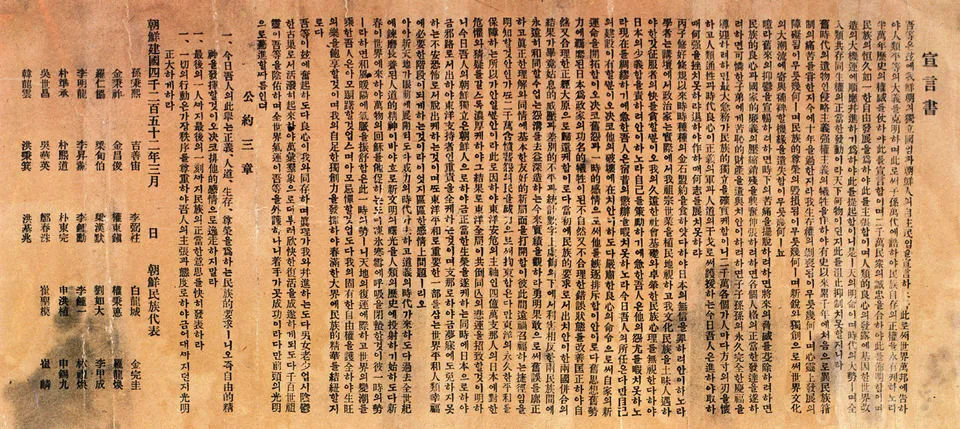
민족대표 33人 · Public domain · Source
Thirty-three leaders of Cheondogyo, Protestant Christianity and Buddhism (15, 16 and 2) chose 1 March, two days before Gojong’s funeral. The declaration, written by Choe Nam-seon, begins "We hereby declare that Korea is an independent state and that Koreans are a free people"; the three public pledges at its end (whether Han Yong-un or Choe Nam-seon wrote them is disputed) called for orderly, peaceful action. The representatives read it at Taehwagwan and then notified the police, while students and citizens read it in Tapgol Park and marched into the streets.
Beginning as non-violent urban protest, the movement spread through shop closures and strikes and then to the countryside, where farmers rose on market days; as the Japanese used force, some attacked township offices and police posts. Demonstrations also broke out at Yongjeong in Jiandao (13 March), in the Maritime Province, at the Korean Liberty Congress in Philadelphia and in Japan. Park Eun-sik’s Bloody History records over two million participants and some 7,500 dead.
The largest national movement, joined by every class, it led to the Provisional Government and forced Japan to replace military rule with "cultural rule". It also influenced the May Fourth Movement in China and the non-violent movement in India.
