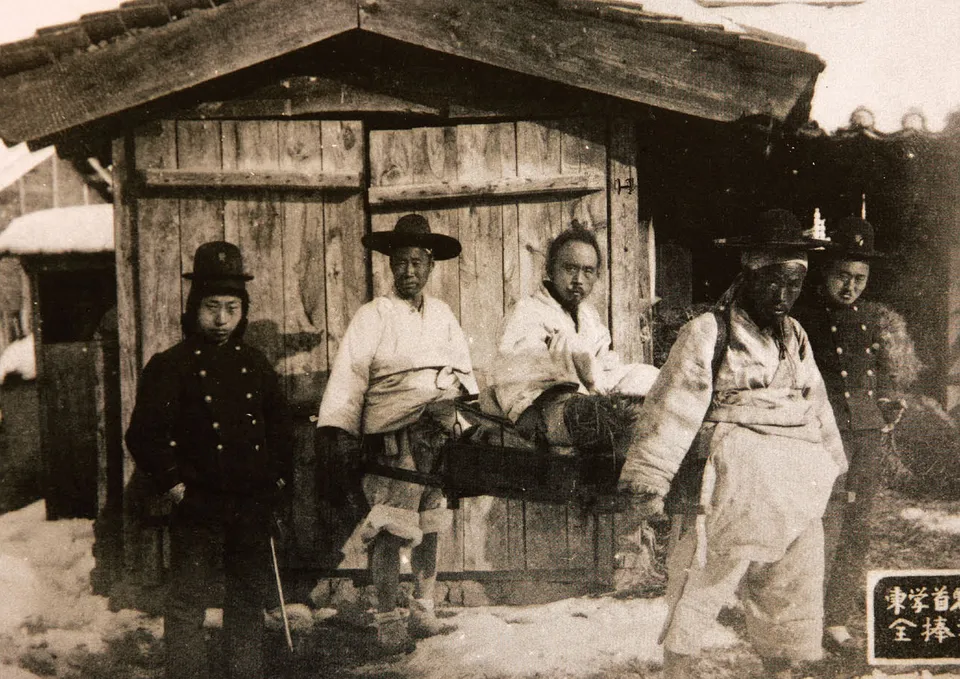
Jeon Bong-jun under arrest, photographed by Murakami Tenshin, 1895

Murakami Tenshin (村上天眞) · Public domain · Source

Person1855 – 1895

Jeon Bong-jun

Leader of the Donghak peasant army, nicknamed the 'Mung Bean General'

In 1894, against the exactions of the Gobu magistrate Jo Byeong-gap, he circulated a round-robin petition (sabal tongmun) and seized the Gobu county office (the Gobu Peasant Uprising). At Baeksan he then issued a manifesto calling to "drive out tyranny, save the people, protect the nation and secure the people" with four principles, defeated government troops at Hwangtohyeon and Hwangnyongchon, and captured Jeonju. When Qing and Japanese troops arrived he made the Jeonju Truce with the government and set up local directorates (jipgangso) in Jeolla to carry out reforms. After Japanese troops seized Gyeongbokgung, the southern and northern Donghak groups rose together again but were crushed at Ugeumchi near Gongju. Captured at Sunchang, he was executed in 1895.

Where they went

OpenFreeMap © OpenMapTiles © OpenStreetMap contributors

6 related events

  1. Peasant armies led by Jeon Bong-jun rose against corrupt officials and foreign powers, triggering the First Sino-Japanese War.

  2. 1

    Against the extortion of Gobu magistrate Jo Byeong-gap, Jeon Bong-jun led peasants to seize the county office, tear down the Manseokbo weir and share out the seized grain.

  3. 2

    Rising again at Mujang, the peasant army gathered at Baeksan, set up the Honam Righteous Army headquarters and issued its manifesto and four principles.

  4. 3

    The peasant army routed the Jeolla provincial troops at Hwangtohyeon in Jeongeup, then beat the government army from Seoul at Hwangnyongchon in Jangseong.

  5. 4

    When the peasants took Jeonju, the government called in Qing troops and Japan sent its own. In return for reform and the withdrawal of both armies, the peasants made peace with the government and withdrew.

  6. 5
    1894Battle of Ugeumchicommander

    Risen again to drive out Japan, the combined Southern and Northern Donghak armies were crushed by government and Japanese troops at Ugeumchi near Gongju; Jeon Bong-jun was captured at Sunchang.

Related works

  • TV drama: Nokdu FlowerDramatizedTV drama · 2019 · Shin Kyung-soo · SBS
  • TV episode: Naked Korean History Episode 25: 1894 — Why Did Jeon Bong-jun Take Up the Bamboo Spear?TV episode · 2022 · Yu Ba-da · tvN STORY

Dramatized works (films, dramas, novels) may differ from the historical record.

People who appear alongside

  • Gojong1852 – 1919

    Twenty-sixth king of Joseon and first emperor of the Korean Empire

  • Jo Byeong-gap1844 – 1912

    Magistrate of Gobu whose extortion over the Manseokbo reservoir provoked the 1894 uprising

  • Choe Si-hyeong1827 – 1898

    Second leader of Donghak who organized its scriptures and, in the second uprising of 1894, joined the Northern Assembly to the Southern

  • Son Byong-hi1861 – 1922

    Third leader of Donghak and founder of Cheondogyo; head of the 33 national representatives of 1919

Themes this person appears in

  • The Opening of East Asia1839 – 1901

    From the Opium War to the Boxer Protocol — sixty years in which China, Japan and Korea, forced open by Western gunboats, each tried to reform and went separate ways

  • GongjuAD 475 – 1894

    From Ungjin, Baekje’s second capital, to Ugeumchi — the town on the Geum River that became the heart of Chungcheong

  • JeonjuAD 685 – 1894

    From Wansanju, capital of Later Baekje, to the ancestral seat of the Joseon royal house — where the Annals were saved and the Donghak army took the fortress