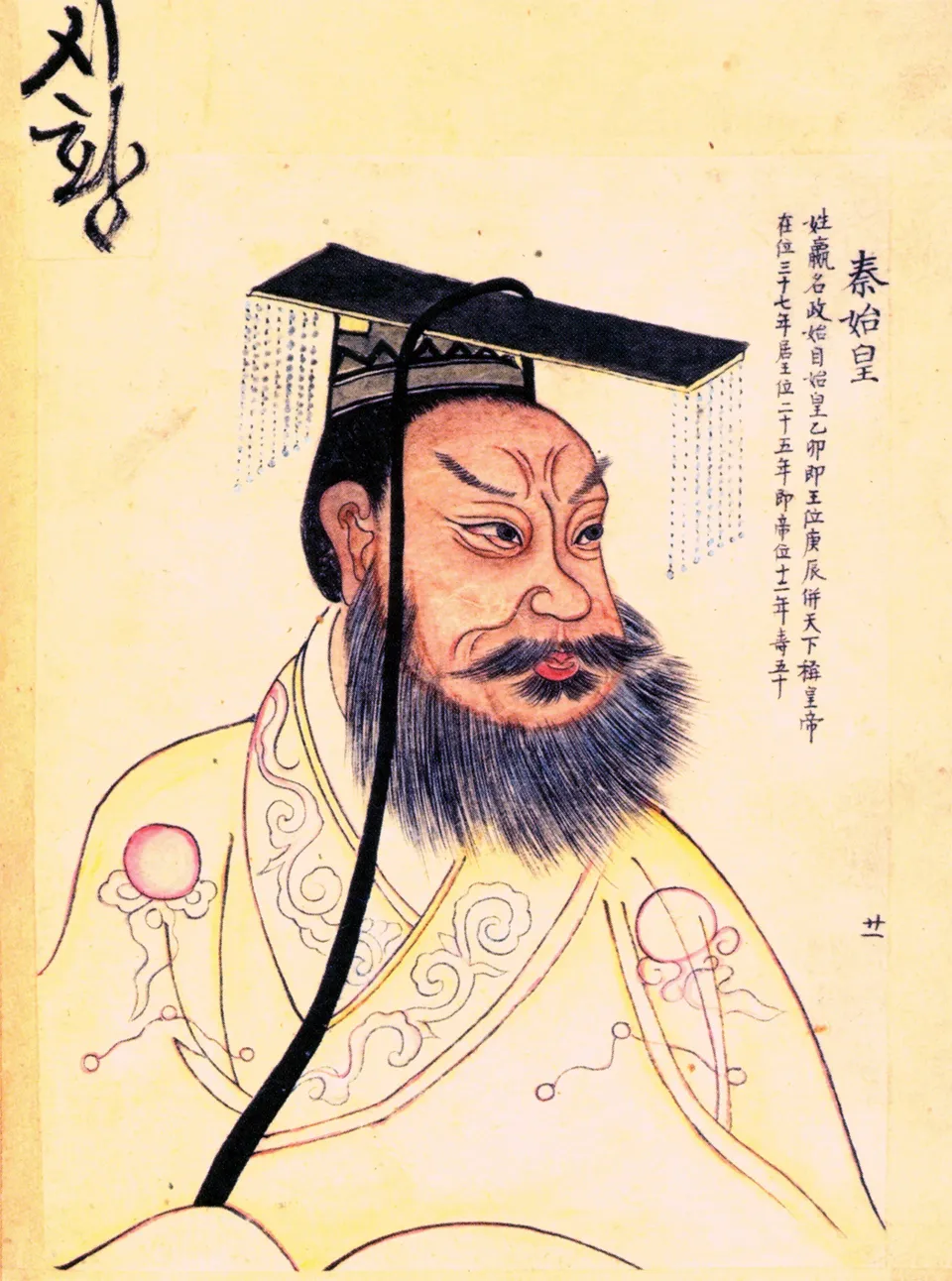
Qin Shi Huang — an imagined portrait, 19th century

Unknown (18??–18??) · Public domain · Source

Person259 BC – 210 BC

Qin Shi Huang

Also called: First Emperor of Qin, Ying Zheng

King of Qin (247–221 BCE) and first emperor (221–210 BCE) who conquered the six other states, unified China and created a centralised imperial system

He became King of Qin at thirteen under the regency of the chancellor Lü Buwei, and after taking power himself used ministers such as Li Si to destroy the six other states between 230 and 221 BCE. Calling himself the First Emperor, he centralised the state through commanderies and counties and the standardisation of script, coinage and measures. He controlled thought by burning books and burying scholars, had Meng Tian link the Great Wall against the Xiongnu, and built the Epang Palace and his vast tomb with its Terracotta Army. He died at Shaqiu in 210 BCE on the last of five tours of the empire.

Where they went

OpenFreeMap © OpenMapTiles © OpenStreetMap contributors

8 related events

  1. 1

    As soon as he became king of Qin at thirteen, the future First Emperor began building his tomb at the foot of Mount Li. In 1974 farmers digging a well found the life-size clay army that guards it.

  2. 2

    Fearing that Qin would swallow his state, Crown Prince Dan of Yan sent the assassin Jing Ke, who approached King Zheng of Qin with a dagger hidden in a map scroll but failed to strike him and was killed.

  3. 3

    Qin conquered the other six Warring States and unified China for the first time. The First Emperor standardised script, coinage and measures.

  4. 4

    Longing for immortality, the First Emperor sent the magician Xu Fu to fetch an elixir from the islands of the immortals in the eastern sea. Xu Fu sailed with thousands of boys and girls and never returned, leaving legends of his landing in Japan and on Jeju.

  5. 5

    The First Emperor gave General Meng Tian 300,000 men to drive the Xiongnu north and join the old walls of Qin, Zhao and Yan into a wall stretching from Lintao to Liaodong. Most of the Great Wall standing today was rebuilt much later by the Ming.

  6. 6

    In 213 BCE, on the advice of Chancellor Li Si, books other than Qin’s histories and practical manuals were burned; the next year, it is said, more than 460 scholars and magicians accused of slandering the emperor were buried alive at Xianyang.

  7. 7

    When the First Emperor died at Shaqiu on his fifth tour in 210 BCE, the eunuch Zhao Gao and Chancellor Li Si hid his death and forged his will, forcing his eldest son Fusu to kill himself and placing the youngest son Huhai on the throne as Second Emperor.

  8. 8

    The year after the First Emperor died, conscripts on their way to the frontier rose under Chen Sheng and Wu Guang. The revolt spread across the country and Qin collapsed fifteen years after unification.

Related works

Dramatized works (films, dramas, novels) may differ from the historical record.

People who appear alongside

  • Li Si280 BC – 208 BC

    Chancellor of Qin; a Legalist who helped the First Emperor unify China, create the commanderies and standardise the script, and proposed the burning of the books. After the emperor’s death he joined Zhao Gao in forging the will, but was executed on Zhao Gao’s slander

  • Meng Tian210 BC

    Qin general who drove the Xiongnu out of the Ordos with an army of 300,000 and joined up the frontier walls; after the Shaqiu plot he was forced to take his own life by a forged edict

  • Jing Ke227 BC

    Warring States swordsman from Wey who, at the request of Crown Prince Dan of Yan, tried and failed to assassinate King Zheng of Qin (the future First Emperor), and was killed

  • Xu Fu

    Qin court magician (fangshi) sent by the First Emperor to find the elixir of immortality; he sailed with thousands of boys and girls and never returned. Legends place him in Japan and on Jeju

  • Zhao Gao207 BC

    Qin eunuch who placed Huhai on the throne as Second Emperor in the Shaqiu plot and seized power after bringing down Li Si; remembered for “calling a deer a horse”

  • Chen Sheng208 BC

    Peasant rebel at the end of Qin who rose with Wu Guang at Dazexiang in 209 BCE, founded Zhangchu and proclaimed himself king

  • Xiang Yu232 BC – 202 BC

    General from a noble Chu family who destroyed Qin’s main army and became Hegemon-King of Western Chu, but killed himself after losing to Liu Bang at Gaixia

  • Liu Bang (Emperor Gaozu of Han)195 BC

    First emperor of Han (r. 202–195 BCE), a petty official from Pei who defeated Xiang Yu in the Chu–Han contention and founded the dynasty

Themes this person appears in

  • Ancient China and India770 BC – AD 220

    From the Hundred Schools of the Warring States to the unified empires of Qin and Han, and from the Buddha to the Maurya and Kushan empires — the millennium that shaped East and South Asian civilisation