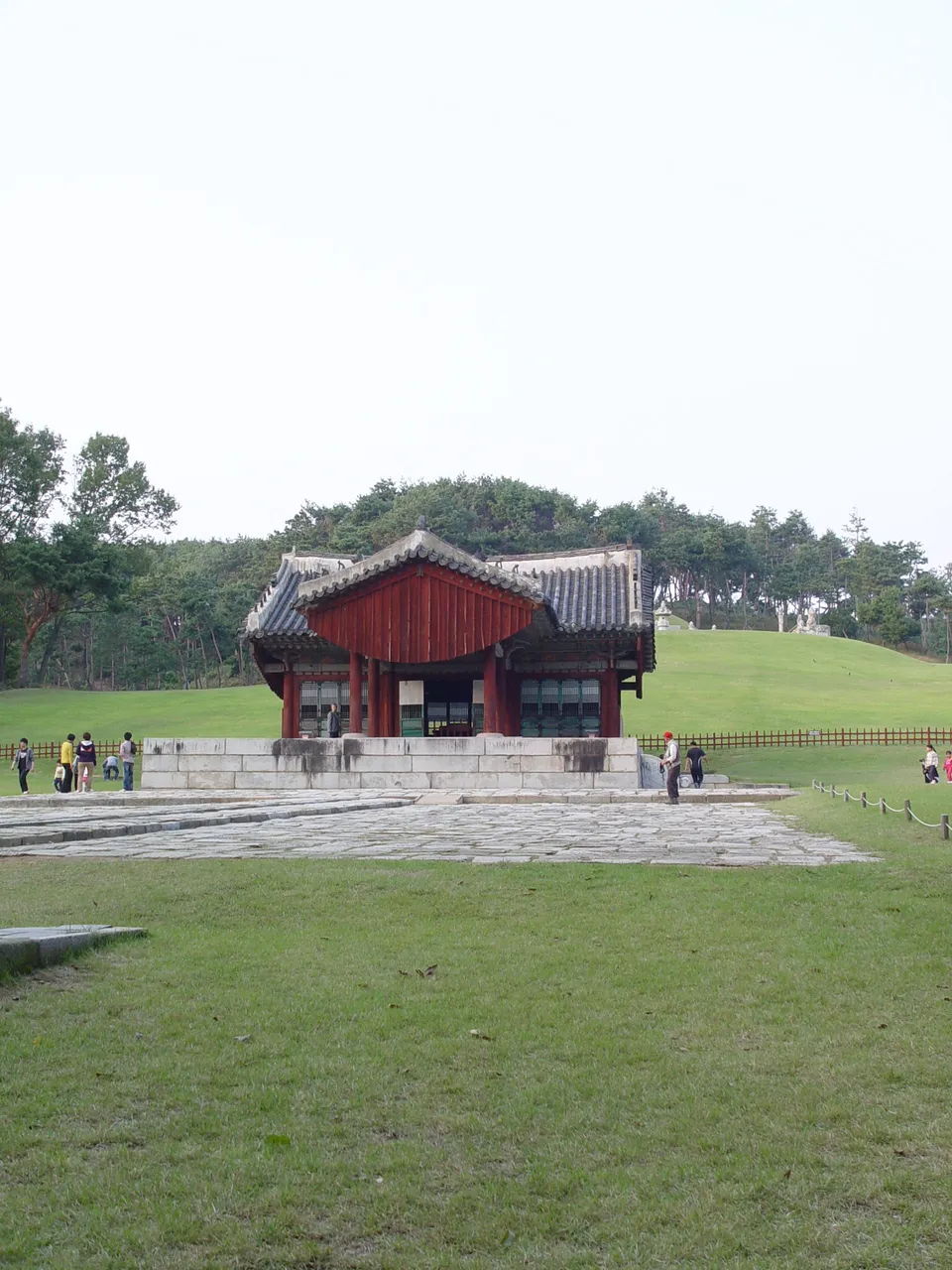
Geolleung, the tomb of King Jeongjo, Hwaseong

Jpbarrass · Public domain · Source

Person1752 – 1800

Jeongjo

Twenty-second king of Joseon, founder of the Gyujanggak library and builder of Hwaseong Fortress

Crown Prince Sado's son. On taking the throne in 1776 he founded the Gyujanggak, a royal library and research institute, and employed sons of concubines such as Yu Deuk-gong and Park Je-ga as copyists. He set up the chogye munsin system to retrain young officials. The Sinhae Tonggong of 1791 abolished the market monopoly rights of licensed merchants other than the Six Licensed Shops. In 1793 he created the Jangyongyeong royal guard, and he built Hwaseong Fortress in Suwon in 1794–1796, with Jeong Yak-yong helping in its design. He published the Daejeon tongpyeon and the Muye dobo tongji. He continued the policy of impartiality and also employed Southerners.

Where they went

OpenFreeMap © OpenMapTiles © OpenStreetMap contributors

11 related events

  1. 1

    Illustrated records of royal weddings, funerals, investitures and building works, in text and pictures; Memory of the World since 2007.

  2. 2

    A royal diary that grew out of the journal Jeongjo kept as crown grandson; Memory of the World since 2011.

  3. 3

    On taking the throne, Jeongjo founded the Gyujanggak in the rear garden of Changdeokgung as a royal library and policy research institute.

  4. 4

    In late Joseon the seoeol (sons of concubines) and the jungin petitioned collectively against discrimination in office. Under Jeongjo the way opened for the seoeol, and in 1851 restrictions on them were largely lifted.

  5. 5

    The court painter Kim Hong-do depicted commoners at work and play — the village school, wrestling, a boy dancer — in humorous circular compositions without backgrounds.

  6. 6

    Yun Ji-chung, a Catholic of yangban birth in Jinsan, was executed for burning his mother’s ancestral tablet and refusing the rites — the first major crackdown on Catholicism.

  7. 7
    1791Sinhae Tonggongmonarch

    On Chae Je-gong’s advice, Jeongjo abolished the licensed market merchants’ right to suppress unlicensed traders, except for the Six Licensed Stores; private trade expanded.

  8. 8

    Jeongjo created the Jangyongyeong royal guard with an inner garrison in the capital and an outer one at Hwaseong in Suwon; through the chogye munsin system he retrained young officials.

  9. 9
    1794 – 1796Hwaseong Fortress builtleader

    Jeongjo built a new fortress at Suwon, where he had moved his father’s tomb. Jeong Yak-yong helped design it and introduced a crane; the work was recorded in a detailed royal protocol.

  10. 10

    When a great famine struck Jeju, the merchant Kim Man-deok spent her fortune on rice from the mainland and saved the starving; King Jeongjo summoned her to Hanyang and granted her wish.

  11. 11

    In 1795 King Jeongjo took his mother, Lady Hyegyeong, to Hwaseong — where his father Crown Prince Sado lay in Hyeollyungwon — for her sixtieth birthday. The whole journey was recorded in the Wonhaeng Eulmyo Jeongni Uigwe and painted on folding screens.

Related works

  • Film: The Fatal EncounterDramatizedFilm · 2014 · Lee Jae-kyoo
  • TV drama: Lee San, Wind of the PalaceDramatizedTV drama · 2007 · Lee Byung-hoon · MBC
  • TV drama: The Red SleeveDramatizedTV drama · 2021 · Jung Ji-in, Song Yeon-hwa · MBC
  • Documentary: History Special Episode 147: Hwaseong in Suwon Was a Cutting-Edge 18th-Century FortressDocumentary · 2002 · KBS1
  • Documentary: HD History Special Episode 58: Joseon's Greatest Mystery Death: Was Jeongjo Poisoned?Documentary · 2006 · KBS1
  • TV episode: The Day: History Journal Episode 1: Jeongjo: The Son of a Condemned Man Becomes KingTV episode · 2013 · KBS1
  • TV episode: Naked Korean History Episode 26: How Did Jeongjo Avenge His Father's Sorrow?TV episode · 2022 · Jeong Hae-deuk · tvN STORY
  • TV episode: Naked Korean History Episode 59: How Did Dasan Jeong Yak-yong Become Jeongjo's Right-Hand Man?TV episode · 2023 · Yun Seok-ho · tvN STORY

Dramatized works (films, dramas, novels) may differ from the historical record.

People who appear alongside

  • Cheoljong1831 – 1863

    Twenty-fifth king of Joseon, raised on Ganghwa and placed on the throne by the Andong Kim clan; after the 1862 uprisings he set up an office to reform the three taxes

  • Park Je-ga1750 – 1805

    Northern Learning scholar of secondary-son birth who served as a Gyujanggak editor; his Bukhagui urged learning from Qing and encouraging consumption to spur production

  • Yu Deuk-gong1748 – 1807

    Gyujanggak editor of secondary-son birth whose Balhaego placed Balhae in Korean history and coined the term “Northern and Southern States”

  • Kim Hong-do (Danwon)1745

    Court painter who portrayed King Jeongjo and is best known for genre scenes of commoners such as The Village School and Ssireum; he died around 1806

  • Yun Ji-chung1759 – 1791

    Catholic of Jinsan executed for burning his mother’s ancestral tablet and refusing Confucian rites (the Jinsan incident)

  • Yi Seung-hun1756 – 1801

    First Korean baptized a Catholic, in Beijing in 1784; he founded the first Korean Catholic community and was executed in 1801

  • Chae Je-gong1720 – 1799

    Southerner minister trusted by Jeongjo who proposed the 1791 abolition of the licensed merchants’ monopoly and oversaw the building of Hwaseong

  • Jeong Yak-yong (Dasan)1762 – 1836

    Silhak scholar who helped design Hwaseong; exiled to Gangjin, where he wrote the Mongmin simseo

Themes this person appears in

  • Factional Politics in Joseon1498 – 1863

    From the literati purges to in-law government — how Sarim factions moved from coexistence and checks to purges and one-faction rule, then through Tangpyeong to the dominance of a few clans

  • Islamic Empires and the Atlantic World1500 – 1800

    Three centuries in which the Ottomans of Suleiman I, the Mughals of Akbar and the Safavids of Abbas I flourished and then faltered, while across the Atlantic the slave trade and colonies transformed the Americas, leading to American independence

  • Military Systems Through the AgesAD 685 – 1907

    From the Nine Oath Banners to the Two Armies and Six Guards, the Five Commands and garrison system, the Five Army Camps and the Board of Marshals — armies rebuilt at every crisis

  • Reformation and Absolutism1517 – 1796

    From Luther’s Ninety-five Theses to Catherine the Great — the wars of religion of a divided Christendom ended at Westphalia, and absolute monarchs armed with divine right, standing armies, bureaucracies and mercantilism, followed by the enlightened despots of eastern Europe, contended for the balance of power among sovereign states

  • Changes in Architecture1200 – 1910

    From Geungnakjeon at Bongjeongsa to Seokjojeon at Deoksugung — Goryeo bracket styles, Joseon palaces, walls and multi-storey temple halls, and the Western buildings of the Korean Empire

  • The Course of Korean PaintingAD 450 – 1897

    From Goguryeo tomb murals to Jang Seung-eop — daily life and guardian deities, Goryeo Buddhist painting, early Joseon landscapes, true-view landscapes and genre painting, literati and folk painting

  • Printing and Documentary HeritageAD 751 – 2011

    From the Dharani Sutra to the May 18 archives — woodblock and metal-type printing, and the records inscribed on the Memory of the World

  • Science and Technology HeritageAD 633 – 1861

    From Cheomseongdae to the Daedong yeojido — instruments and maps that measured the sky, kept time, gauged rain and charted the land

  • Intangible and World Heritage2000 BC – 1850

    From the dolmens to Namhansanseong on the World Heritage List, from Jongmyo ritual music to ssireum on the Intangible Heritage lists — where each came from and when it was inscribed

  • Ganghwa Island1000 BC – 2011

    From dolmens to the Treaty of Ganghwa — Goryeo’s refuge capital and the stage of Korea’s opening, the island the kingdom fell back on in every crisis

  • Suwon1601 – 1919

    From Jeongjo’s new city of Hwaseong to the tragedy of Jeam-ri — where a king’s filial devotion and reform politics were built into stone walls

  • Jeju Island1270 – 1948

    From Tamna to Jeju — the Sambyeolcho’s last stand, Yuan horse ranches, castaways and exiles, and the island of April 3