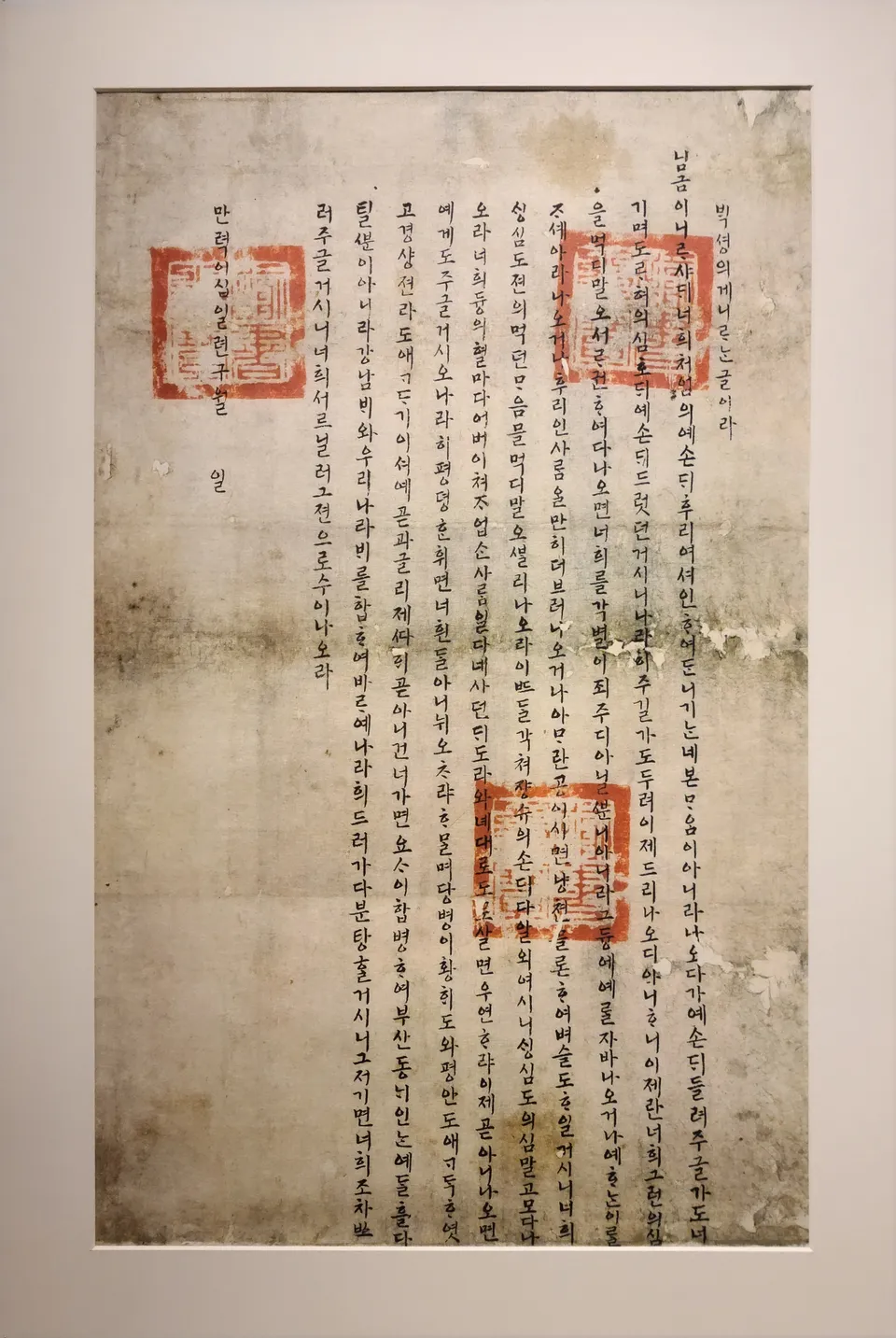
King Seonjo’s royal edict to the people written in Hangeul, 1593

Namoroka · Public domain · Source

Person1552 – 1608

King Seonjo

Fourteenth king of Joseon; fled to Uiju and asked Ming for help

He brought the sarim into government in large numbers, but in 1575 they split into Easterners and Westerners, and the Jeong Yeo-rip treason case of 1589 led to the Gichuk Purge. When the Imjin War broke out in 1592 he fled Hanyang via Pyongyang to Uiju. During the war he set up the Military Training Command, and he ordered Heo Jun to compile the Dongui bogam.
Where they went

OpenFreeMap © OpenMapTiles © OpenStreetMap contributors

10 related events

  1. 1
    1568Yi Hwang’s Seonghak sipdorelated figure

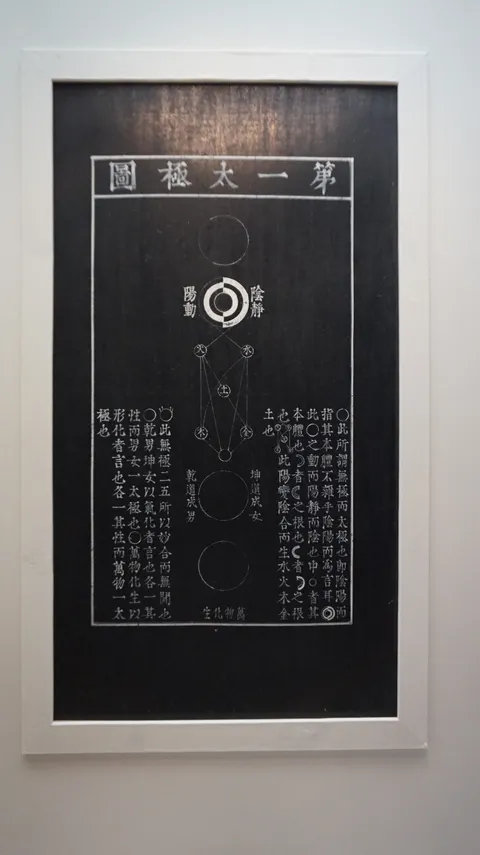
    Yi Hwang presented the Seonghak sipdo (Ten Diagrams on Sage Learning), summarising Neo-Confucianism in ten diagrams, to King Seonjo, who had come to the throne at sixteen.

  2. 2

    A clash between Kim Hyo-won and Sim Ui-gyeom over a key personnel post split the Sarim into Easterners and Westerners, beginning factional politics.

  3. 3
    1575Yi I’s Seonghak jipyorelated figure

    Yi I presented to King Seonjo the Seonghak jipyo (Essentials of Sage Learning), summarising Neo-Confucianism and the learning of kings.

  4. 4

    Accused of plotting rebellion, the Easterner Jeong Yeo-rip took his own life, and the purge led by the Westerner Jeong Cheol struck down some thousand Easterners.

  5. 1592 – 1598Imjin Warmonarch

    A seven-year war that began with Japan's invasion of Joseon in 1592 and lasted until 1598. Ming China sent troops, turning it into an East Asian international war.

  6. 5

    At news of the defeat at Chungju, King Seonjo left Hanyang in the rain before dawn on the 30th. He went by Gaeseong and Pyongyang to Uiju on the Yalu and asked Ming for help.

  7. 6

    Ming sent troops at Joseon’s request. Zu Chengxun’s first force was beaten at Pyongyang in July; while Shen Weijing bought time, Li Rusong crossed the Yalu with over 40,000 men in December.

  8. 7

    During the Imjin War, on Ryu Seong-ryong’s advice, the Hullyeon Dogam was founded to train musketeers, archers and spearmen. It was a standing army of paid soldiers.

  9. 8

    Having lost Pyongyang and been checked at Byeokjegwan and Haengju, the Japanese left Hanyang under the peace talks. On the 20th of the fourth month Ming and Korean troops entered the capital after a year.

  10. 9

    In 1596, while Ming and Japan were negotiating peace during the Imjin War, Yi Mong-hak, an illegitimate descendant of the royal house, rose in revolt at Hongsan in Chungcheong. The revolt collapsed before Hongju fortress, and the righteous-army leader Kim Deok-ryeong died in prison after being implicated.

People who appear alongside

  • Ryu Seong-ryong1542 – 1607

    Chief State Councillor who directed the war effort during the Imjin War, proposed the Hullyeon Dogam, and wrote the Jingbirok

  • Li Rusong1549 – 1598

    Ming general who led the relief army and retook Pyongyang with Joseon forces

  • Yi Hwang (Toegye)1501 – 1570

    Leading Neo-Confucian scholar who secured a royal charter for Baegundong Academy

  • Kim Hyo-won1542 – 1590

    Clashed with Sim Ui-gyeom over a key personnel post and became leader of the Easterners

  • Sim Ui-gyeom1535 – 1587

    The queen's brother, who opposed Kim Hyo-won and led the Westerners

  • Jo Sik (Nammyeong)1501 – 1572

    Neo-Confucian scholar of western Gyeongsang who stressed reverence, righteousness and practice; his disciples formed the Northerners and led militias in the Imjin War

  • Yi I (Yulgok)1536 – 1584

    Neo-Confucian scholar who founded the Giho school; author of the Seonghak jipyo, Dongho mundap and Gyeongmong yogyeol, and advocate of reforms

  • Kim Jang-saeng (Sagye)1548 – 1631

    Yi I's disciple who carried on the Giho school and laid the foundations of Joseon ritual studies with the Garye jipram

Themes this person appears in

  • Imjin War1592 – 1598

    From the Japanese invasion to the Battle of Noryang — the righteous armies, Yi Sun-sin at sea, and Ming intervention

  • Factional Politics in Joseon1498 – 1863

    From the literati purges to in-law government — how Sarim factions moved from coexistence and checks to purges and one-faction rule, then through Tangpyeong to the dominance of a few clans

  • Ming, Qing and Edo Japan1500 – 1800

    The age when the Ming, shaken by northern raiders, southern pirates and the silver economy, fell to Li Zicheng’s rebels, and the Manchu Qing reached its greatest extent and prosperity under Kangxi, Yongzheng and Qianlong — as Japan was unified out of the Warring States into the Edo shogunate’s bakuhan order and closed country, and Joseon, after two great wars, met its neighbours through embassies to Edo and the Northern Learning

  • Islamic Empires and the Atlantic World1500 – 1800

    Three centuries in which the Ottomans of Suleiman I, the Mughals of Akbar and the Safavids of Abbas I flourished and then faltered, while across the Atlantic the slave trade and colonies transformed the Americas, leading to American independence

  • Military Systems Through the AgesAD 685 – 1907

    From the Nine Oath Banners to the Two Armies and Six Guards, the Five Commands and garrison system, the Five Army Camps and the Board of Marshals — armies rebuilt at every crisis

  • Reformation and Absolutism1517 – 1796

    From Luther’s Ninety-five Theses to Catherine the Great — the wars of religion of a divided Christendom ended at Westphalia, and absolute monarchs armed with divine right, standing armies, bureaucracies and mercantilism, followed by the enlightened despots of eastern Europe, contended for the balance of power among sovereign states

  • AndongAD 930 – 1940

    From the Battle of Gochang that helped found Goryeo to Yi Hwang’s Dosan Seowon — home of Goryeo wooden halls and Yeongnam Confucianism

  • JeonjuAD 685 – 1894

    From Wansanju, capital of Later Baekje, to the ancestral seat of the Joseon royal house — where the Annals were saved and the Donghak army took the fortress