World history1939 – 194518 events
World War II
From the invasion of Poland to the surrender of Japan — the largest war in human history, across Europe, Asia and the Pacific
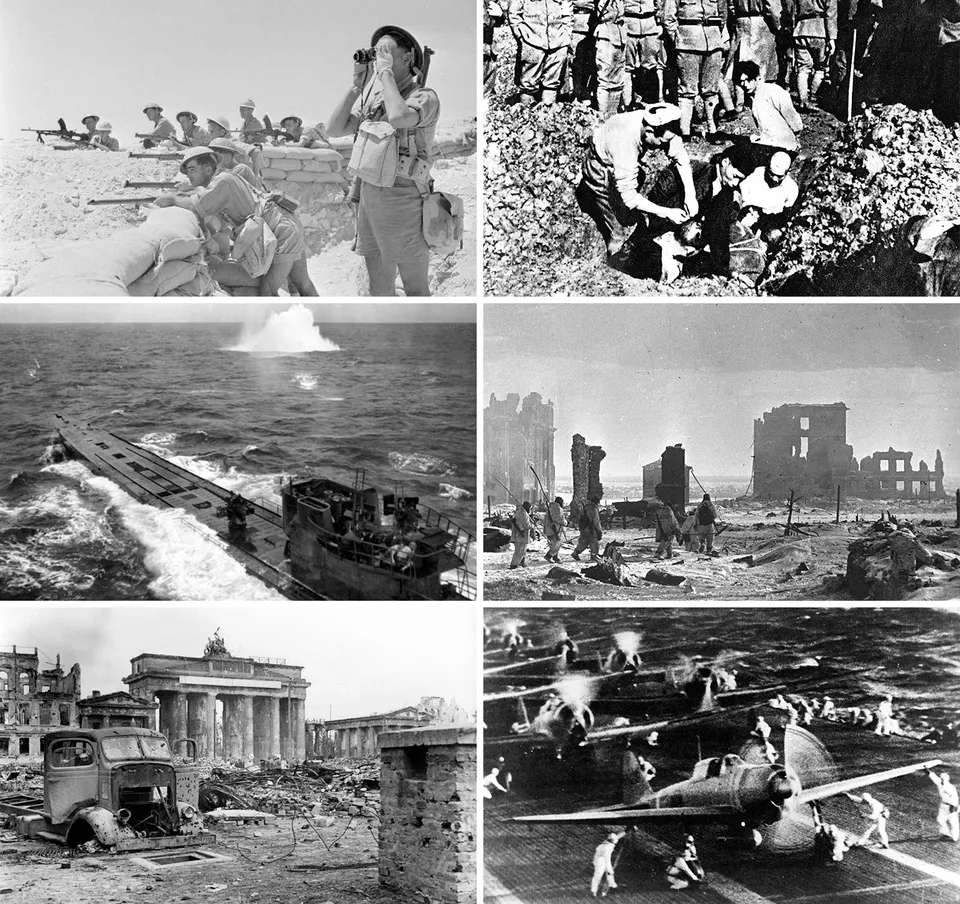
Oberiko ( talk · contribs ) · Public domain · Source
From the invasion of Poland to the surrender of Japan — the largest war in human history, across Europe, Asia and the Pacific
Oberiko ( talk · contribs ) · Public domain · Source
Germany invaded Poland, and Britain and France declared war on Germany, beginning the Second World War. The Soviet Union attacked Poland from the east.
Beginning with Germany's invasion of Poland, the largest war in human history was fought across Europe, Asia and the Pacific.
German armour broke through the Ardennes and defeated France in six weeks; the British escaped by sea from Dunkirk and France signed an armistice.
The Luftwaffe tried to win control of the air ahead of an invasion but could not defeat the RAF, which fought back with radar and fighters; Hitler postponed the landing.
Nazi Germany systematically murdered about six million European Jews; Roma, disabled people, prisoners of war and others were also victims.
Breaking the non-aggression pact, Germany launched a surprise invasion of the Soviet Union. It drove to the gates of Moscow but was halted by winter and a Soviet counter-attack.
Japanese naval aircraft made a surprise attack on the US Pacific Fleet at Pearl Harbor, Hawaii. America entered the war, which spread across the Pacific (the Pacific War).
Having broken Japan’s codes, the US Navy ambushed the Japanese fleet bound for Midway and sank four carriers, turning the tide of the Pacific War.
German and Soviet forces fought for more than five months in the streets of Stalingrad on the Volga. The Soviets encircled and forced the surrender of the German Sixth Army, turning the tide of the war in the east.
British forces under Montgomery defeated Rommel’s German–Italian army at El Alamein in Egypt, turning the tide in North Africa.
Germany attacked the Kursk salient but was stopped by deep Soviet defences. The largest tank battle in history, it handed the initiative on the Eastern Front to the Soviet Union.
The leaders of the United States, Britain and China met in Cairo and declared that Korea would become free and independent in due course, the first international pledge of Korean independence.
Allied forces under Eisenhower landed on the coast of Normandy, opening a western front; Paris was liberated in August.
Roosevelt, Churchill and Stalin met at Yalta in Crimea and agreed on the occupation of Germany, the founding of the UN and Soviet entry into the war against Japan, laying the foundations of the post-war order and the Cold War.
Soviet forces took Berlin and Hitler killed himself. Germany surrendered unconditionally on 8 May, ending the war in Europe (VE Day).
The United States dropped atomic bombs on Hiroshima and Nagasaki. More than 200,000 people died in the two cities that year, and Japan surrendered soon after.
On 15 August 1945 Japan's surrender ended its rule over Korea. US and Soviet troops moved in on either side of the 38th parallel.
Japan accepted the Potsdam Declaration and Emperor Hirohito announced the surrender by radio on 15 August. The instrument of surrender was signed aboard USS Missouri in Tokyo Bay on 2 September, ending the Second World War.
Nazi leader and Führer of Germany (1934–1945) who started the Second World War and perpetrated the Holocaust; he killed himself as Berlin fell
General Secretary of the Soviet Communist Party who ruled the USSR from the late 1920s until his death, led the war against Germany and drew Eastern Europe into the Soviet bloc
Marshal of the Soviet Union who directed the defence of Moscow, the Stalingrad counter-offensive and Kursk, and took Berlin
British prime minister (1940–1945, 1951–1955) who led Britain’s resistance through the Battle of Britain and named the “Iron Curtain” in 1946
Commander of Japan’s Combined Fleet who planned the attack on Pearl Harbor and the Midway operation; shot down over the South Pacific in 1943
32nd US president (1933–1945) who led the New Deal and took the US to war after Pearl Harbor; he attended the Cairo and Yalta conferences
Commander of the US Pacific Fleet who directed the Battle of Midway and signed Japan’s instrument of surrender for the United States
British general who defeated Rommel at the Second Battle of El Alamein and commanded the ground forces in the Normandy landings
German field marshal, “the Desert Fox”, who led the Afrika Korps; implicated in the plot against Hitler, he was forced to take his own life
French general who refused the 1940 surrender and led Free France from London; later president of the Fifth Republic (1959–1969)
Known as Baekbeom; founded the Korean Patriotic Organization and led the Liberation Army as Chairman of the Provisional Government
Supreme Allied Commander who directed the Normandy landings; later 34th US president (1953–1961), who brought about the Korean armistice