Explorationc. 60,000–50,000 years ago

Out of Africa

Also called: Out of Africa dispersal, Southern dispersal

About 60,000 to 50,000 years ago one branch of modern humans left Africa and spread into Asia. Over tens of thousands of years their descendants reached Australia, Europe and the Americas.
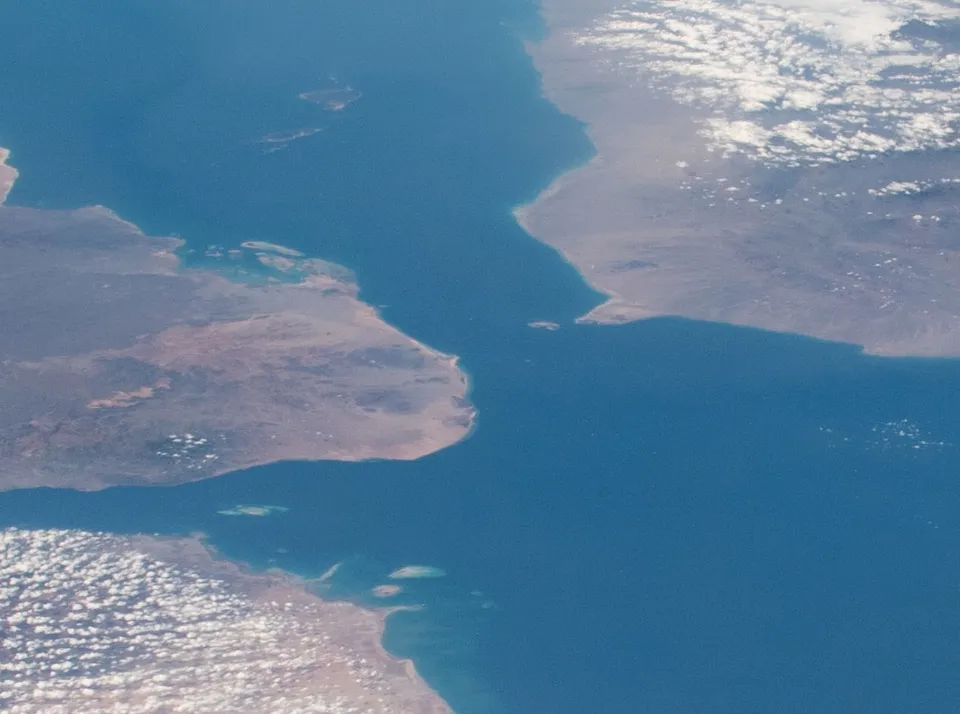
The Bab-el-Mandeb strait between Africa (left) and Arabia, seen from the International Space Station

Earth Science and Remote Sensing Unit, NASA Johnson Space Center · Public domain · Source

Modern humans had left Africa before: bones 180,000 to 100,000 years old come from the caves of Misliya, Skhul and Qafzeh in Israel. But those groups left little clear trace in people living today.

Most people living outside Africa today descend from a small group that left about 60,000 to 50,000 years ago. Scholars discuss a southern route — across the Bab-el-Mandeb strait at the mouth of the Red Sea, when ice-age seas were low, and along the coasts of Arabia — and a northern route through Sinai into the Levant.

They spread quickly along coasts and rivers, reaching South and Southeast Asia within a few thousand years, crossing by boat to Australia and moving north into Europe and Siberia. The Americas were reached only in the last ice age, over the Bering land bridge.

The map in c. 60,000 years ago

OpenFreeMap © OpenMapTiles © OpenStreetMap contributors

Places
Bab-el-Mandeb

5 parts of this event

  1. 1
    c. 50,000 years agoFirst peoples of Australia

    In the ice age Australia and New Guinea formed one continent, Sahul. People reached it from Southeast Asia by crossing the sea several times — by about 50,000 years ago at the latest — in what is counted among the oldest sea voyages.

  2. 2
    c. 50,000 years ago – c. 43,500 years agoMeeting the Neanderthals and Denisovans

    Modern humans who left Africa had children with Neanderthals in western Asia about 50,000 to 43,000 years ago, and mixed with Denisovans in Asia. Neanderthals contributed 1–2% of the genes of people outside Africa today.

  3. 3
    c. 45,000 years agoModern humans in Europe

    Modern humans entered Europe about 45,000 years ago and lived alongside Neanderthals for several thousand years. About 36,000 years ago they painted animals in Chauvet Cave in France.

  4. 4
    c. 40,000 years agoModern humans in East Asia

    Modern humans lived in northern China (Tianyuan Cave) about 40,000 years ago, and from about that time an Upper Palaeolithic culture of blades and tanged points spread across Korea and the Japanese islands.

  5. 5

    People from Siberia crossed the ice-age Bering land bridge into the Americas, reaching Monte Verde in Chile by about 14,500 years ago. Footprints at White Sands, New Mexico, are dated to 23,000–21,000 years ago.

Before and after

Earlier
c. 300,000 years ago Emergence of Homo sapiens

Themes that include this event

  • The Human Journeyc. 300,000 years ago – 1300

    How modern humans, who appeared in Africa some 300,000 years ago, left Africa, met the Neanderthals, crossed the sea to Australia and the ice-age Bering land bridge to the Americas, and finally reached the remotest islands of the Pacific