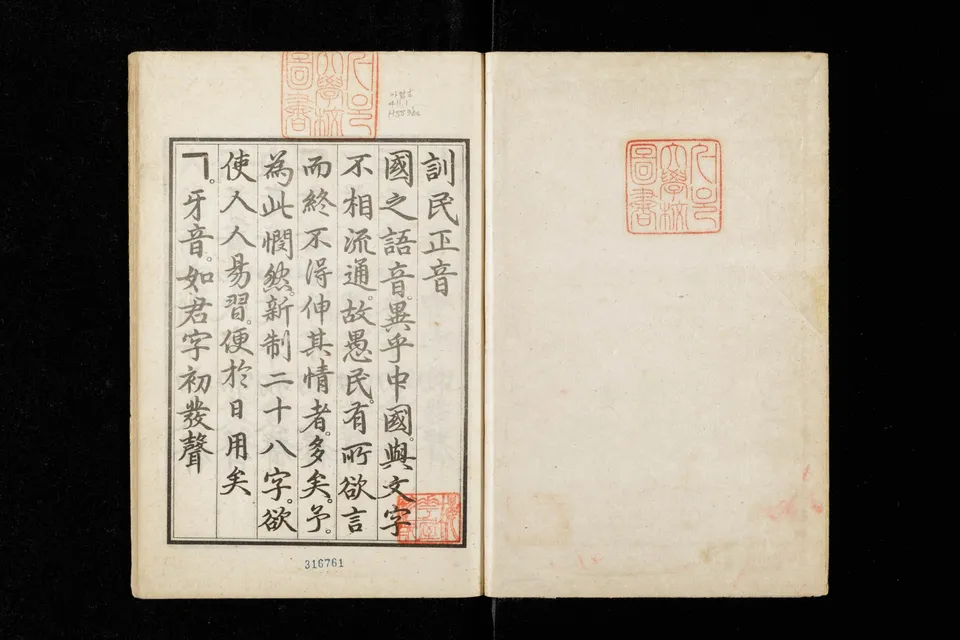
Hunminjeongeum Haerye (facsimile)

Government of Joseon · Public domain · Source

Person1397 – 1450

Sejong the Great

Fourth king of Joseon, creator of Hangul, patron of science and of the northern frontier

Taejong's third son. He expanded the Jiphyeonjeon to train scholars and, through the Uijeongbu seosa system, shared state business with the chief ministers. He created Hunminjeongeum in 1443 and promulgated it in 1446, and had the Yongbi eocheonga and Worin cheongang jigok composed. He published the Nongsa jikseol, the Chiljeongsan calendar, the Hyangyak jipseongbang and the Samgang haengsildo, had Jang Yeong-sil and others build the Jagyeongnu water clock and the Angbu ilgu sundial and cast the Gabin type, and set up rain gauges in the capital and the counties. He fixed the gongbeop land tax with six grades of land and nine grades of harvest. Abroad he attacked Tsushima, concluded the Gyehae Treaty and opened the Four Commanderies and Six Garrisons. He had Bak Yeon reorganise court music (aak).
Where they went

OpenFreeMap © OpenMapTiles © OpenStreetMap contributors

17 related events

  1. 1

    To strike the pirates at their base, Yi Jong-mu attacked Tsushima with some 200 ships; trade was later allowed under the 1443 treaty.

  2. 2

    Sejong turned the Hall of Worthies into a research institute whose scholars produced the Hunminjeongeum commentary and many other works.

  3. 3

    Sejong had the Joseon Tongbo copper coin made to circulate alongside paper money, but it lost out to rice and cloth.

  4. 4

    Sejong had the advice of experienced farmers in every province gathered into Nongsa jikseol, a manual of farming suited to Korea’s own climate.

  5. 5

    King Sejong built the observation platform Ganuidae at Gyeongbokgung and had the simplified armillary (ganui) and armillary sphere (honcheonui) made.

  6. 6

    Choe Yun-deok set up four commanderies on the upper Yalu and Kim Jong-seo six garrisons on the lower Tumen, laying the basis of Korea's northern border.

  7. 7
    1434Gabin type castmonarch

    Sejong had Yi Cheon, Jang Yeong-sil and others cast a new bronze type, the Gabin type, which became the model of Joseon movable type.

  8. 8

    Jang Yeong-sil built the Jagyeongnu, a water clock that struck bells, drums and gongs on its own; it kept the official time at Gyeongbokgung.

  9. 9

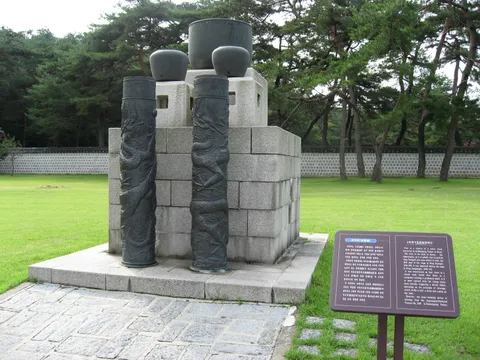
    The angbu ilgu, a sundial shaped like a cauldron facing the sky, was set up by the roads of Hanyang so ordinary people could tell the time.

  10. 10
    1441Rain gaugeleader

    Joseon made the cheugugi rain gauge and installed it in the capital and every county to record rainfall systematically.

  11. 11

    Yi Sun-ji, Kim Dam and others completed the Chiljeongsan, a calendar computing the motions of the sun, moon and five planets for the meridian of Hanyang.

  12. 12
    1443Gyehae Treatymonarch

    Under Sejong, Joseon concluded an agreement with the lord of Tsushima limiting trade with Japan to 50 ships and 200 seok of rice a year.

  13. 13

    Sejong fixed a land tax graded by six classes of soil fertility and nine classes of harvest.

  14. 14

    King Sejong published Hunminjeongeum, a new script he created for ordinary people.

  15. 15

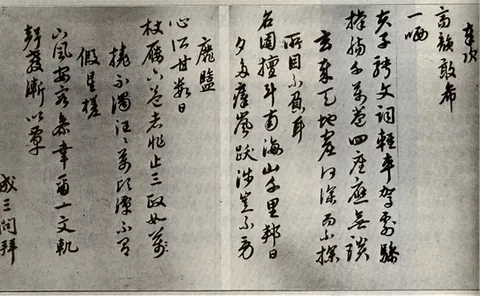
    An Gyeon painted in three days the peach-blossom paradise Prince Anpyeong saw in a dream — a monumental landscape leading from the real world into paradise, masterpiece of early Joseon painting.

  16. 16

    The rite held at Jongmyo for the royal ancestors and the music, songs and dances that accompany it. Botaepyeong and Jeongdaeeop, composed under King Sejong, were adopted for the rite under King Sejo.

  17. 17
    1485Joseon system of governmentrelated figure

    Joseon built a central government around the State Council and Six Ministries, checked by the Three Offices, and a local administration sending governors and magistrates to the eight provinces. It was codified in the Gyeongguk daejeon (1485).

Related works

Dramatized works (films, dramas, novels) may differ from the historical record.

People who appear alongside

  • Jang Yeong-sil

    Scientist of humble birth who built the self-striking water clock for Sejong and helped make astronomical instruments

  • Sin Suk-ju1417 – 1475

    Jiphyeonjeon scholar who helped create Hunminjeongeum, wrote the Haedong jegukgi after a mission to Japan, and became Chief State Councillor under Sejo

  • Jeong In-ji1396 – 1478

    Jiphyeonjeon scholar who wrote the preface to the Hunminjeongeum haerye and led the compilation of the Goryeosa

  • Seong Sam-mun1418 – 1456

    Hall of Worthies scholar executed for plotting to restore Danjong; one of the Six Martyred Ministers

  • Taejong (Yi Bang-won)1367 – 1422

    Third king of Joseon, who seized power in the Strifes of Princes and strengthened royal authority

  • Bak Paeng-nyeon1417 – 1456

    Jiphyeonjeon scholar executed as one of the Six Martyred Ministers for plotting with Seong Sam-mun to restore Danjong

  • Sejo (Grand Prince Suyang)1417 – 1468

    Seized power in the 1453 coup and took the throne from his nephew Danjong

  • Yi Jong-mu1360 – 1425

    Early Joseon general who led the 1419 expedition to Tsushima

Themes this person appears in

  • Song, Ming and Samurai JapanAD 960 – 1500

    The age when the civil-minded Song bought peace from Liao, Western Xia and Jin while the lower Yangtze boomed and Neo-Confucianism took shape, and the Ming, having driven out the Yuan, rebuilt the East Asian order through imperial autocracy, the sea ban and tribute — as Japan passed through the Kamakura and Muromachi warrior governments into the Warring States era, and Korea from Goryeo to Joseon

  • Turkic-Islamic Empires and Other Civilizations1000 – 1533

    From the Ghaznavid raids on India to the Mughal Empire and Suleiman I — five centuries in which Turkic-led Islamic empires took western Asia and India, while Africa, Southeast Asia and the Americas raised civilisations of their own

  • Changes in TaxationAD 755 – 1894

    From land tax, tribute and labour to cash taxes in the Gabo Reform — burdens shifting from people and households to land

  • History of Korean CurrencyAD 996 – 1905

    From Geonwon Jungbo to the 1905 currency reform — how coins took hold in an economy of rice and cloth, and how monetary sovereignty was lost

  • Central Government Through the AgesAD 250 – 1899

    From the noble councils of the Three Kingdoms to the State Council, the Border Defense Council and the Gabo cabinet — how central government shifted between aristocratic consensus and royal power

  • Local Administration Through the AgesAD 250 – 1896

    From the five regions of the Three Kingdoms through nine provinces, the five circuits and two frontiers and the eight provinces to the thirteen — how directly the centre came to rule the regions

  • The Course of Korean PaintingAD 450 – 1897

    From Goguryeo tomb murals to Jang Seung-eop — daily life and guardian deities, Goryeo Buddhist painting, early Joseon landscapes, true-view landscapes and genre painting, literati and folk painting

  • Printing and Documentary HeritageAD 751 – 2011

    From the Dharani Sutra to the May 18 archives — woodblock and metal-type printing, and the records inscribed on the Memory of the World

  • Science and Technology HeritageAD 633 – 1861

    From Cheomseongdae to the Daedong yeojido — instruments and maps that measured the sky, kept time, gauged rain and charted the land

  • Intangible and World Heritage2000 BC – 1850

    From the dolmens to Namhansanseong on the World Heritage List, from Jongmyo ritual music to ssireum on the Intangible Heritage lists — where each came from and when it was inscribed

  • Busan1443 – 1979

    Port of the Japan House and of the 1876 opening — Korea’s gateway to Japan, and wartime capital in the Korean War