Korea · History1919 – 194515 events

The Korean Provisional Government

From Shanghai to Chongqing, 1919 to 1945 — founding and crisis, the Patriotic Organization’s attacks, the wanderings across China, the Liberation Army and the return home
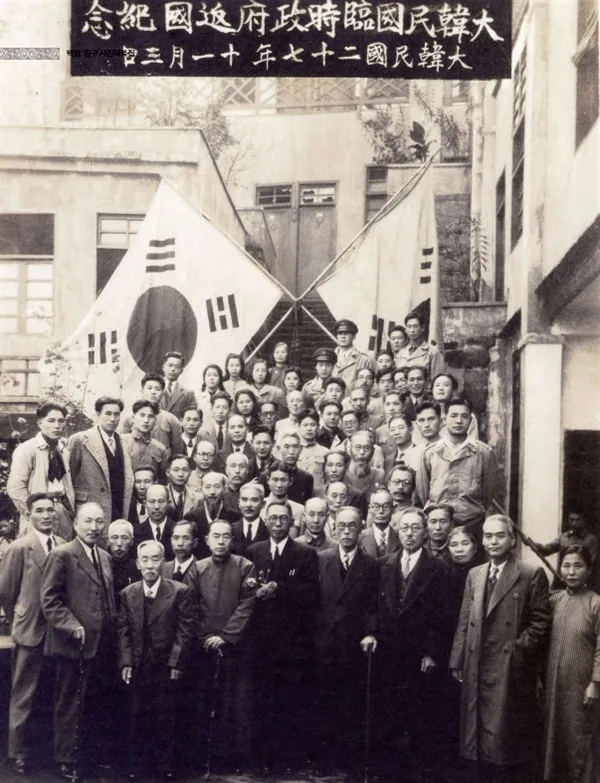
환국을 앞둔 대한민국 임시 정부 요인들 — 1945년 11월 3일 충칭

대한민국 임시정부 - 국사편찬위원회 · Public domain · Source
The theme on the map

OpenFreeMap © OpenMapTiles © OpenStreetMap contributors

15 events in this theme

  1. Beginning on 1 March 1919 with the reading of a declaration of independence, demonstrations spread across the country. It led to the founding of the Provisional Government of the Republic of Korea.

  2. After the March First Movement, on 11 April 1919, the Provisional Government of the Republic of Korea was founded in Shanghai, the first Korean government to adopt a democratic republic. In September it merged the several provisional governments.

  3. Delegates of the independence movement at home and abroad met in Shanghai to decide the future of the Provisional Government. The "creation" and "reform" factions clashed and the conference broke up.

  4. To revive the stagnant Provisional Government, Kim Gu organized the Korean Patriotic Organization in Shanghai to carry out armed attacks.

  5. Korean Patriotic Organization member Yi Bong-chang threw a bomb at the Japanese emperor’s procession outside the Sakuradamon gate in Tokyo. The emperor was unhurt, but Japan was badly shaken.

  6. Korean Patriotic Organization member Yun Bong-gil threw a bomb onto the platform at the celebration of the emperor’s birthday and the Shanghai victory in Hongkou Park, killing and wounding Japanese commanders.

  7. Hunted by Japan after Yun Bong-gil’s attack, the Korean Provisional Government left Shanghai in 1932 and, by way of Hangzhou, Zhenjiang, Changsha, Guangzhou, Liuzhou and Qijiang, settled in Chongqing in 1940 — keeping the government alive through eight years on the move across China.

  8. In May 1938, at a meeting in Nanmuting, Changsha, to unite three independence parties, Yi Un-hwan of the Korean Revolutionary Party opened fire, and Kim Gu was shot in the chest. He survived, but carried the bullet for the rest of his life.

  9. Settled in Chongqing, the Provisional Government founded the Korean Liberation Army under Commander-in-Chief Ji Cheong-cheon; the Korean Volunteer Corps joined it in 1942.

  10. The Provisional Government issued its Founding Principles, based on Jo So-ang’s Doctrine of Three Equalities, setting out the state to be built after liberation.

  11. When Japan attacked Pearl Harbor and the Pacific War began, the Korean Provisional Government in Chongqing declared war on Japan and Germany on 10 December 1941 — resolved to win liberation by fighting as one of the Allies.

  12. The leaders of the United States, Britain and China met in Cairo and declared that Korea would become free and independent in due course, the first international pledge of Korean independence.

  13. On 15 August 1945 Japan's surrender ended its rule over Korea. US and Soviet troops moved in on either side of the 38th parallel.

  14. On 23 November 1945, three months after liberation, Kim Gu and fourteen other Provisional Government leaders landed at Gimpo airfield on a US military plane. Because the US Military Government refused to recognise them as a government, they had to come home as private individuals.

  15. The Korean Liberation Army trained with the US Office of Strategic Services (OSS) for an operation into Korea, but Japan surrendered before it could be carried out.

Key people

  • Kim Gu1876 – 1949

    Known as Baekbeom; founded the Korean Patriotic Organization and led the Liberation Army as Chairman of the Provisional Government

  • Kim Kyu-sik1881 – 1950

    Envoy of the New Korea Youth Party to the Paris Peace Conference, later Vice-Chairman of the Provisional Government

  • Ji Cheong-cheon1888 – 1957

    Commander of the Korean Independence Army in the joint Korea–China campaigns and Commander-in-Chief of the Liberation Army

  • Jo So-ang1887 – 1958

    Author of the Doctrine of Three Equalities, the basis of the 1941 Founding Principles

  • Syngman Rhee1875 – 1965

    First President of the Provisional Government, who worked through diplomacy in the US; later first President of the Republic of Korea

  • Ahn Chang-ho1878 – 1938

    Founder of the Sinminhoe and the Heungsadan; as Interior Minister of the Provisional Government he set up the yeontongje network

  • Yi Dong-nyeong1869 – 1940

    Sinminhoe member who helped found the Sinheung school in western Jiandao and served as Speaker of the Provisional Assembly and head of the Provisional Government

  • Yi Si-yeong1869 – 1953

    Younger brother of Yi Hoe-yeong who went into exile with his brothers, helped found the Sinheung school, served the Provisional Government as Minister of Justice and Finance and became the first Vice President of the Republic of Korea

  • Lee Beom-seok1900 – 1972

    Officer at the Battle of Cheongsan-ri, later chief of staff and Second Detachment commander of the Korean Liberation Army

  • Yi Dong-hwi1873 – 1935

    Vice-president of the Korean Gwangbokgun Government and first Premier of the Provisional Government; founded the Korean Socialist Party

  • Yeo Un-hyeong1886 – 1947

    Founded the New Korea Youth Party in Shanghai and in 1944 the underground Korean Founding League at home

  • Sin Gyu-sik1880 – 1922

    Founded the Dongjesa in Shanghai and led the 1917 Declaration of Great Unity; served the Provisional Government as Justice Minister and acting Premier