World history1919 – 193925 events

The Great Depression and Totalitarianism

From the Washington Conference to the invasion of Poland — two decades in which the age of international cooperation collapsed in the Depression, fascism, Nazism and Stalinism rose, and the world slid into war again
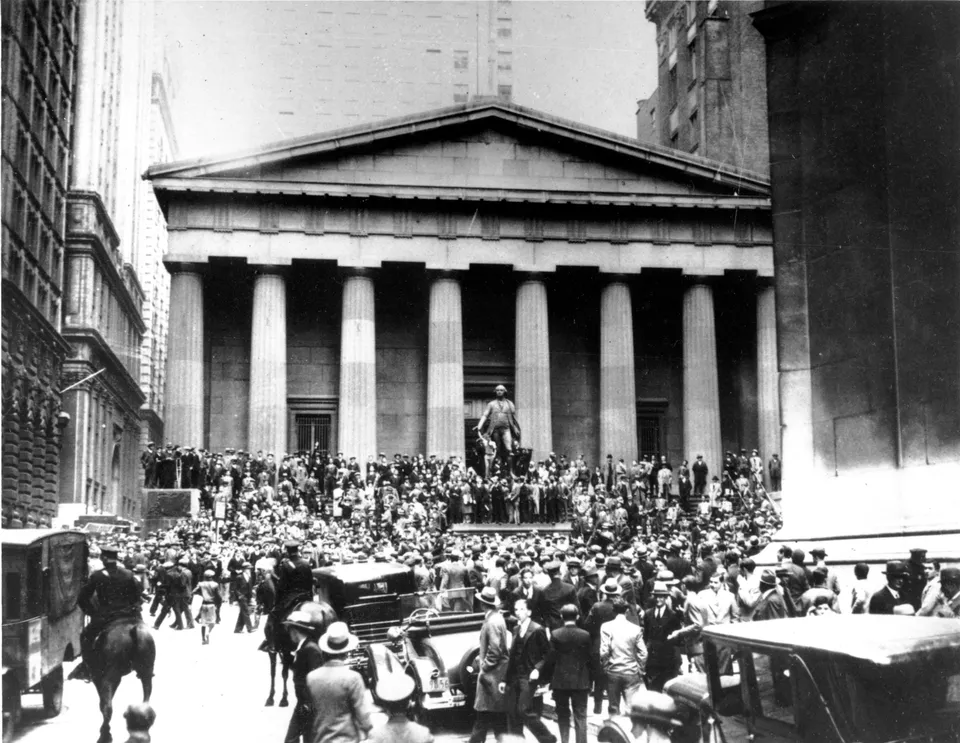
주가 폭락 소식에 뉴욕 월가로 몰려든 군중 — 1929년 10월 24일, 대공황의 시작

Associated Press · Public domain · Source

At a glance

YearCountryEventKey points
1921–22US, UK, Japan …Washington ConferenceCapital ships 5:5:3; Nine-Power Treaty
1922ItalyMarch on RomeMussolini in power; Fascist one-party rule
1923GermanyRuhr occupationReparations; hyperinflation → Dawes Plan
1925Western EuropeLocarno TreatiesWestern borders guaranteed; League (1926)
1928US, France …Kellogg–Briand PactWar renounced; no sanctions
1928USSRFive-Year PlansHeavy industry; collectivization
1929US → worldGreat DepressionBlack Thursday; mass unemployment
1932Britain, FranceEconomic blocsOttawa; imperial preference
1933GermanyHitler in powerEnabling Act; one-party state
1933USNew DealAAA, NIRA, TVA; modified capitalism
1935ItalyInvasion of EthiopiaLeague sanctions fail
1936GermanyRhineland remilitarizedVersailles and Locarno broken
1936–39SpainSpanish Civil WarGermany, Italy back Franco; Intl Brigades
1936–37Germany, Italy, JapanAxis; Anti-Comintern PactAnti-communist Axis bloc
1938GermanyMunich AgreementSudetenland ceded; appeasement
1939Germany, USSRNazi–Soviet PactSecret protocol splits Poland

The theme on the map

OpenFreeMap © OpenMapTiles © OpenStreetMap contributors

25 events in this theme

  1. At America’s invitation the powers met in Washington to limit naval armaments and settle Pacific and Chinese questions, creating the Washington system that held Japanese expansion in check in Asia and the Pacific.

  2. As Mussolini’s Fascists (the Blackshirts) converged on Rome, the king made Mussolini prime minister. Italy had the first Fascist government.

  3. When Germany fell behind on reparations, France and Belgium occupied the industrial Ruhr. The German government answered with passive resistance financed by printing money, and the mark collapsed.

  4. Germany, France and Belgium agreed to respect each other’s borders, with Britain and Italy as guarantors. Germany joined the League of Nations the next year as a spirit of international cooperation took hold.

  5. On the initiative of French foreign minister Briand and US Secretary of State Kellogg, the powers pledged to renounce war as an instrument of national policy.

  6. Having taken power after Lenin’s death, Stalin ended the New Economic Policy, built up heavy industry under state plans and forced the peasants into collective farms.

  7. 1929 – 1939Great Depression

    An economic crisis that began with the 1929 crash on Wall Street spread around the world, collapsing production and trade and throwing millions out of work. How nations met the crisis set democracies and totalitarian states on different paths.

  8. Share prices on the New York Stock Exchange began to plunge on 24 October 1929 and collapsed on “Black Tuesday”, the 29th — the starting point of the Great Depression.

  9. Collectivization and ruthless grain requisitioning brought famine to Ukraine and other Soviet grain lands in 1932–1933, and millions starved to death.

  10. Amid the Depression Britain, France and others bound home countries and colonies together and raised high tariffs against outsiders. The world economy split into separate blocs.

  11. Hitler, whose Nazi Party had become the largest in the Reichstag during the Depression, was made chancellor and used the Enabling Act, which handed lawmaking power to the government, to build a one-party dictatorship. The Weimar Republic collapsed.

  12. 1933 – 1939New Deal

    Taking office in the depths of the Depression, President Franklin Roosevelt launched the New Deal, using active government intervention to bring relief, recovery and reform.

  13. Timed to the Nazi Party rally in Nuremberg, Nazi Germany enacted racial laws that stripped Jews of citizenship and banned their marriage to Germans.

  14. Mussolini’s Italy invaded and annexed Ethiopia, an independent African state. The League of Nations’ sanctions ended in failure.

  15. Hitler sent troops into the Rhineland, which the Treaties of Versailles and Locarno had made a demilitarized zone. Britain and France confined themselves to protests.

  16. 1936 – 1939Spanish Civil War

    Army officers led by Franco rose against the Popular Front government, starting a civil war of almost three years. With Germany and Italy backing the rebels and the Soviet Union and the International Brigades aiding the Republic, it became a prelude to the Second World War.

  17. Claiming to root out “enemies of the people”, Stalin had Party officials, army commanders, intellectuals and ordinary citizens arrested en masse and shot or sent to the camps.

  18. Germany and Italy formed the Rome–Berlin Axis, and Germany and Japan signed the Anti-Comintern Pact against communism. Italy joined the following year, binding the three powers together.

  19. Germany’s Condor Legion and the Italian air force bombed the small Basque town of Guernica and left it in ruins. It became a symbol of indiscriminate bombing aimed at civilians.

  20. Claiming they might spy for Japan, Stalin’s regime forcibly moved more than 170,000 Koreans from the Russian Far East, including the Maritime Province, to Kazakhstan and Uzbekistan.

  21. Hitler sent troops into Austria and joined it to Germany — Nazi Germany’s first territorial expansion, justified as uniting the German people in one state.

  22. The leaders of Britain, France, Italy and Germany met in Munich and, without Czechoslovakia, agreed to hand the Sudetenland to Germany — the high point of appeasement.

  23. Across Nazi Germany, Jewish synagogues, shops and homes were attacked and burned. It is called “Kristallnacht” (Crystal Night) for the broken glass that covered the streets.

  24. Ideological enemies Nazi Germany and the Soviet Union promised not to attack each other and divided Eastern Europe in a secret protocol. Nine days later Germany invaded Poland.

  25. Germany invaded Poland, and Britain and France declared war on Germany, beginning the Second World War. The Soviet Union attacked Poland from the east.

Key people

  • Adolf Hitler1889 – 1945

    Nazi leader and Führer of Germany (1934–1945) who started the Second World War and perpetrated the Holocaust; he killed himself as Berlin fell

  • Benito Mussolini1883 – 1945

    Founder of Italian Fascism who became prime minister (1922–1943) after the March on Rome; dictator who invaded Ethiopia and allied with Hitler

  • Joseph Stalin1878 – 1953

    General Secretary of the Soviet Communist Party who ruled the USSR from the late 1920s until his death, led the war against Germany and drew Eastern Europe into the Soviet bloc

  • Gustav Stresemann1878 – 1929

    Weimar chancellor (1923) and foreign minister (1923–1929) who ended the hyperinflation and brought Germany back into the international community through Locarno

  • Vyacheslav Molotov1890 – 1986

    Stalin’s close associate, Soviet premier (1930–1941) and foreign commissar, who signed the Nazi–Soviet Non-Aggression Pact in 1939

  • Aristide Briand1862 – 1932

    French statesman, many times prime minister, who as foreign minister championed the Locarno Treaties and the Kellogg–Briand Pact

  • Herbert Hoover1874 – 1964

    31st US president (1929–1933), whose first year in office brought the stock market crash and the Great Depression

  • Franklin D. Roosevelt1882 – 1945

    32nd US president (1933–1945) who led the New Deal and took the US to war after Pearl Harbor; he attended the Cairo and Yalta conferences

  • Neville Chamberlain1869 – 1940

    British prime minister (1937–1940) who pursued appeasement of Hitler and signed the Munich Agreement, then declared war after the invasion of Poland

  • Francisco Franco1892 – 1975

    General who led the Nationalist rebels to victory in the Spanish Civil War and ruled Spain as dictator from 1939 until his death

  • Joachim von Ribbentrop1893 – 1946

    Nazi Germany’s foreign minister (1938–1945) who concluded the Anti-Comintern Pact and the Nazi–Soviet Pact; executed after the Nuremberg trials

  • Syngman Rhee1875 – 1965

    First President of the Provisional Government, who worked through diplomacy in the US; later first President of the Republic of Korea